A Guide to Human-Centered Data Strategy
It’s About People, Not Just Technology
The central idea behind a modern, successful data strategy is a simple but powerful one:
Technology doesn’t create advantage , people do.
This means that a human-centered approach prioritizes how people work together and learn, recognizing that tools like AI are only valuable when they enhance human expertise. Any initiative that focuses only on technology without considering the people who use it is destined to fail.
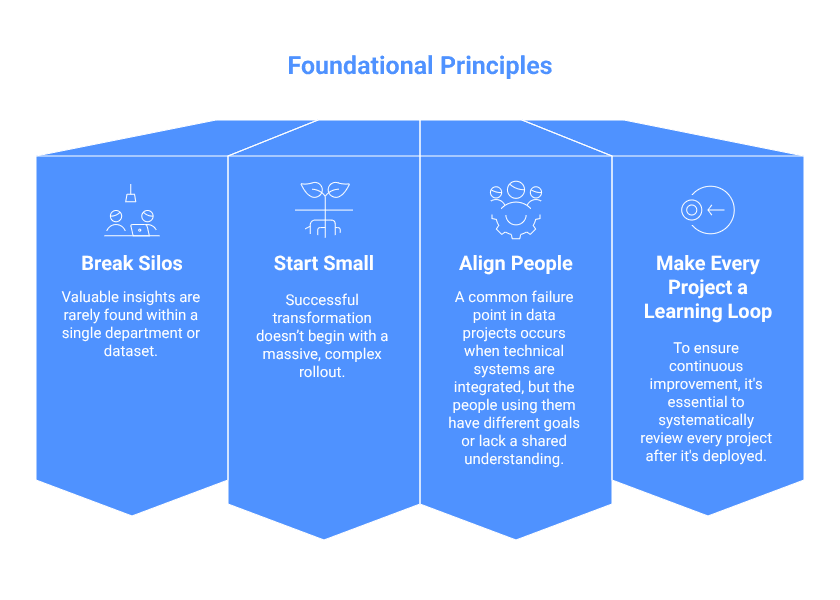
This philosophy is built on four foundational principles designed to ensure data initiatives deliver real, sustainable value. Let's explore each of these principles in detail.
The Four Foundational Principles
Principle 1: Break Silos , Data Work is Social
Valuable insights are rarely found within a single department or dataset. Real progress happens only when people with different roles and contexts—like planners, operators, analysts, and decision-makers—share their knowledge alongside the data. This collaborative process uncovers a much richer understanding than any isolated, static dashboard ever could.
Collaboration > dashboards.
Principle 2: Start Small, Learn Fast, Scale Smart
Successful transformation doesn’t begin with a massive, complex rollout. Instead, it starts with a single, well-defined project. Focusing on one meaningful use case with measurable outcomes is far more effective because it builds momentum through clear, tangible wins. This approach is more powerful than starting with a project that has a huge but vague scope.
Momentum builds from clarity, not scope.
Principle 3: Align People, Not Just Systems
A common failure point in data projects occurs when technical systems are integrated, but the people using them have different goals or lack a shared understanding. The most important type of integration is creating shared goals and a common language across teams. This human alignment is what ensures technology is used effectively and strategically, preventing situations where people and algorithms pull in different directions.
Alignment is the real integration layer.
Principle 4: Make Every Project a Learning Loop
To ensure continuous improvement, it's essential to systematically review every project after it's deployed. This practice involves capturing what worked, what didn’t, and why. By feeding these lessons forward into the next project, an organization creates a cycle of improvement. This reframes scaling not as a function of deploying more technology, but as a function of institutionalizing knowledge. This deliberate learning process is the modern and most effective way to "scale" success across an organization.
Learning is the new scaling.
While powerful individually, these four principles create a reinforcing system: breaking silos enables small projects to succeed, clear alignment gives them strategic purpose, and learning loops ensure that every success scales intelligently across the organization.
Conclusion: The Real Source of Advantage
Ultimately, a successful data strategy is not about having the most advanced technology; it’s about nurturing the people who use it. By breaking down silos to foster collaboration, starting small to build momentum, aligning teams around shared goals, and creating learning loops for continuous improvement, organizations can unlock lasting value. This human-centered focus ensures that technology serves its true purpose: AI delivers value only when it enhances human expertise, collaboration, and learning.
The central idea behind a modern, successful data strategy is a simple but powerful one:
Technology doesn’t create advantage , people do.
This means that a human-centered approach prioritizes how people work together and learn, recognizing that tools like AI are only valuable when they enhance human expertise. Any initiative that focuses only on technology without considering the people who use it is destined to fail.
This philosophy is built on four foundational principles designed to ensure data initiatives deliver real, sustainable value. Let's explore each of these principles in detail.
The Four Foundational Principles
Principle 1: Break Silos , Data Work is Social
Valuable insights are rarely found within a single department or dataset. Real progress happens only when people with different roles and contexts—like planners, operators, analysts, and decision-makers—share their knowledge alongside the data. This collaborative process uncovers a much richer understanding than any isolated, static dashboard ever could.
Collaboration > dashboards.
Principle 2: Start Small, Learn Fast, Scale Smart
Successful transformation doesn’t begin with a massive, complex rollout. Instead, it starts with a single, well-defined project. Focusing on one meaningful use case with measurable outcomes is far more effective because it builds momentum through clear, tangible wins. This approach is more powerful than starting with a project that has a huge but vague scope.
Momentum builds from clarity, not scope.
Principle 3: Align People, Not Just Systems
A common failure point in data projects occurs when technical systems are integrated, but the people using them have different goals or lack a shared understanding. The most important type of integration is creating shared goals and a common language across teams. This human alignment is what ensures technology is used effectively and strategically, preventing situations where people and algorithms pull in different directions.
Alignment is the real integration layer.
Principle 4: Make Every Project a Learning Loop
To ensure continuous improvement, it's essential to systematically review every project after it's deployed. This practice involves capturing what worked, what didn’t, and why. By feeding these lessons forward into the next project, an organization creates a cycle of improvement. This reframes scaling not as a function of deploying more technology, but as a function of institutionalizing knowledge. This deliberate learning process is the modern and most effective way to "scale" success across an organization.
Learning is the new scaling.
While powerful individually, these four principles create a reinforcing system: breaking silos enables small projects to succeed, clear alignment gives them strategic purpose, and learning loops ensure that every success scales intelligently across the organization.
Conclusion: The Real Source of Advantage
Ultimately, a successful data strategy is not about having the most advanced technology; it’s about nurturing the people who use it. By breaking down silos to foster collaboration, starting small to build momentum, aligning teams around shared goals, and creating learning loops for continuous improvement, organizations can unlock lasting value. This human-centered focus ensures that technology serves its true purpose: AI delivers value only when it enhances human expertise, collaboration, and learning.



All rights reserved to Data Raven Technologies