AI Project Success: A 4-Part Guide to Implementation
General Description – The Synergy of the 4 Elements
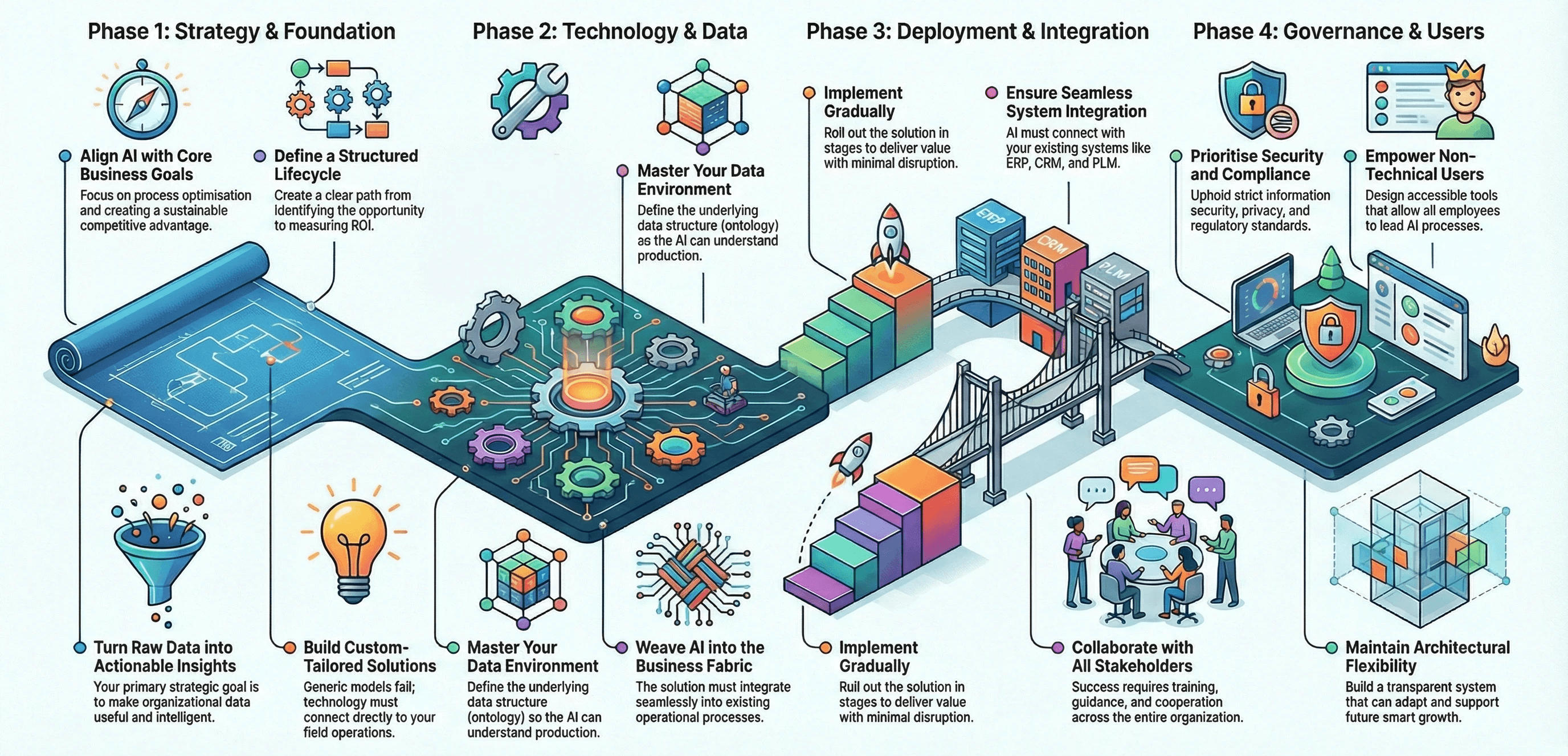
Implementing Artificial Intelligence is rarely a linear technical task; it is a multi-dimensional business transformation. The four elements detailed below—Strategy, Technology, Deployment, and Governance—do not operate in isolation but rather form a dependent lifecycle that ensures the longevity and value of the project.
How They Combine:
The Foundation (Strategy): Acts as the "Why." It anchors the project in business reality rather than hype, ensuring that every subsequent step drives ROI. Without this, the technology has no direction.
The Core (Technology): Acts as the "How." Once the strategy is set, the specific data structures (ontology) and custom models are built to serve that strategy. This layer bridges the gap between abstract business goals and physical field operations.
The Execution (Deployment): Acts as the "When and Where." Even the best technology fails if rejected by the organization. This element ensures the solution is introduced gradually, integrating with legacy systems (ERP/CRM) to minimize friction.
The Guardrails (Governance): Acts as the "Who and Controls." Finally, the system must remain safe, compliant, and accessible. This layer ensures the solution is sustainable, legal, and usable by non-technical staff long-term.
Together, these elements transform raw data into a competitive business advantage.
General Description – The Synergy of the 4 Elements
Implementing Artificial Intelligence is rarely a linear technical task; it is a multi-dimensional business transformation. The four elements detailed below—Strategy, Technology, Deployment, and Governance—do not operate in isolation but rather form a dependent lifecycle that ensures the longevity and value of the project.
How They Combine:
The Foundation (Strategy): Acts as the "Why." It anchors the project in business reality rather than hype, ensuring that every subsequent step drives ROI. Without this, the technology has no direction.
The Core (Technology): Acts as the "How." Once the strategy is set, the specific data structures (ontology) and custom models are built to serve that strategy. This layer bridges the gap between abstract business goals and physical field operations.
The Execution (Deployment): Acts as the "When and Where." Even the best technology fails if rejected by the organization. This element ensures the solution is introduced gradually, integrating with legacy systems (ERP/CRM) to minimize friction.
The Guardrails (Governance): Acts as the "Who and Controls." Finally, the system must remain safe, compliant, and accessible. This layer ensures the solution is sustainable, legal, and usable by non-technical staff long-term.
Together, these elements transform raw data into a competitive business advantage.


All rights reserved to Data Raven Technologies