From Activity to Business Model
AI works best when it supports real operations
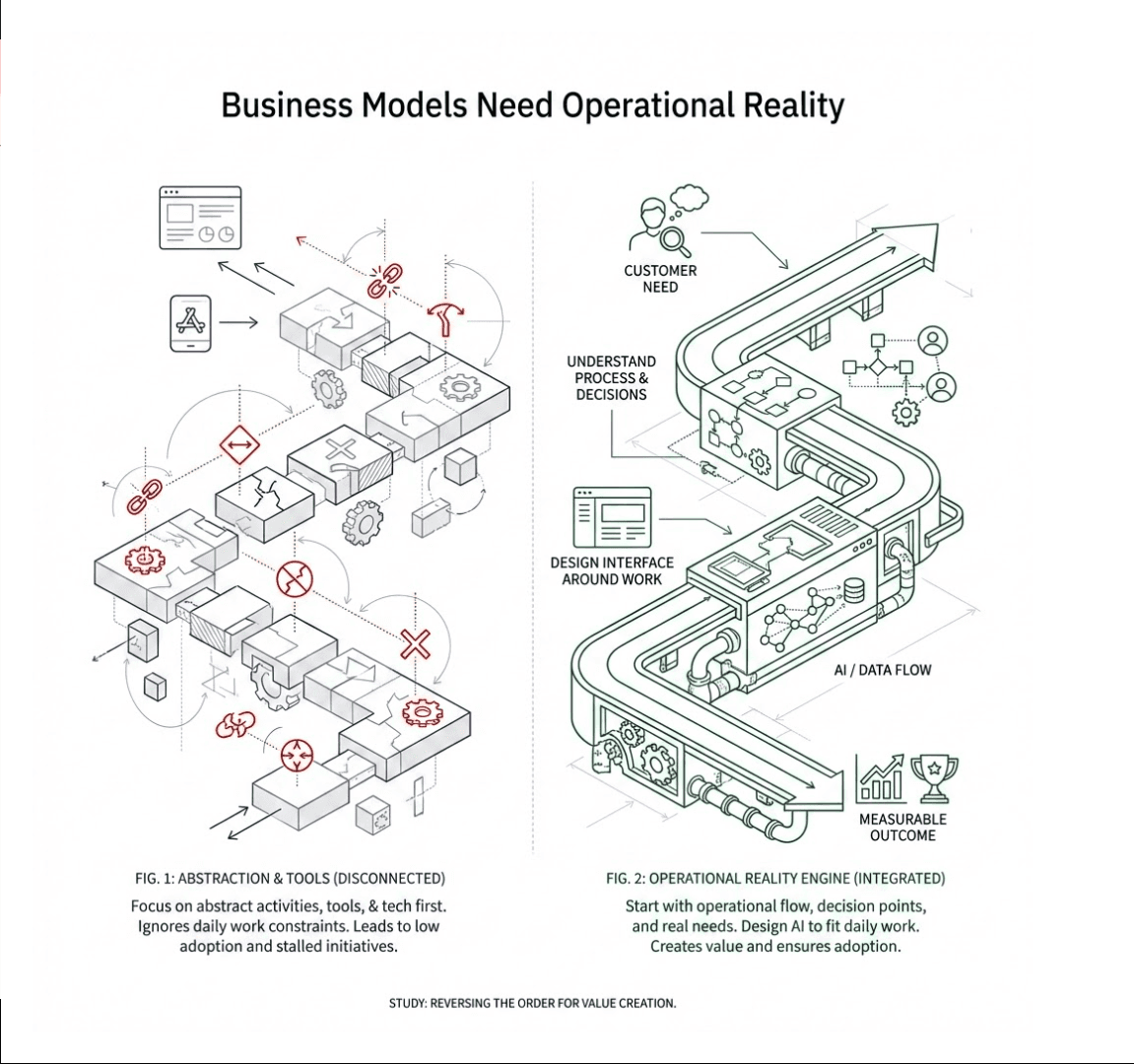
Many organizations say they have a business model, but in practice they often have a set of activities. There is a difference. Activities describe what people do. A business model explains how those activities create value, how that value is delivered, and how the organization sustains it over time.
This matters when companies start working with AI. Too often, AI is added on top of disconnected processes, unclear ownership, and weak decision logic. In that setting, even a strong model can fail to create impact. The problem is not the technology alone. The real issue is that the underlying operating model is not clear enough for the technology to support.
Many organizations say they have a business model, but in practice they often have a set of activities. There is a difference. Activities describe what people do. A business model explains how those activities create value, how that value is delivered, and how the organization sustains it over time.
This matters when companies start working with AI. Too often, AI is added on top of disconnected processes, unclear ownership, and weak decision logic. In that setting, even a strong model can fail to create impact. The problem is not the technology alone. The real issue is that the underlying operating model is not clear enough for the technology to support.
A practical approach starts with the business process, not the tool. Where does work happen today? Which decisions are repeated? Which steps are manual, slow, or inconsistent? Which data already exists, and which systems must remain in place? These are the questions that help separate useful AI opportunities from attractive but unrealistic ideas.
In industrial companies and municipalities, this distinction is especially important. Operations are complex, people are busy, and trust matters. If a solution cannot fit existing workflows, explain its output clearly, and show measurable value over time, adoption will be limited. That is why gradual implementation is often the right path. Start with one process, one decision point, or one team. Prove value. Learn. Then expand.
The same logic applies to enterprise AI. The goal is not to make AI look impressive in isolation. The goal is to make it useful inside a real business model. That means connecting data, systems, and people in a way that supports daily work and long-term performance.
At Data Raven, we focus on that practical bridge. We help organizations identify where AI and analytics can create value, connect them to real workflows, and implement them with discipline. When the business model is clear, technology becomes far easier to apply well.
A practical approach starts with the business process, not the tool. Where does work happen today? Which decisions are repeated? Which steps are manual, slow, or inconsistent? Which data already exists, and which systems must remain in place? These are the questions that help separate useful AI opportunities from attractive but unrealistic ideas.
In industrial companies and municipalities, this distinction is especially important. Operations are complex, people are busy, and trust matters. If a solution cannot fit existing workflows, explain its output clearly, and show measurable value over time, adoption will be limited. That is why gradual implementation is often the right path. Start with one process, one decision point, or one team. Prove value. Learn. Then expand.
The same logic applies to enterprise AI. The goal is not to make AI look impressive in isolation. The goal is to make it useful inside a real business model. That means connecting data, systems, and people in a way that supports daily work and long-term performance.
At Data Raven, we focus on that practical bridge. We help organizations identify where AI and analytics can create value, connect them to real workflows, and implement them with discipline. When the business model is clear, technology becomes far easier to apply well.


All rights reserved to Data Raven Technologies