The Multi-Seed Strategy
Building AI That Scales in Industrial and Service-Driven Organizations
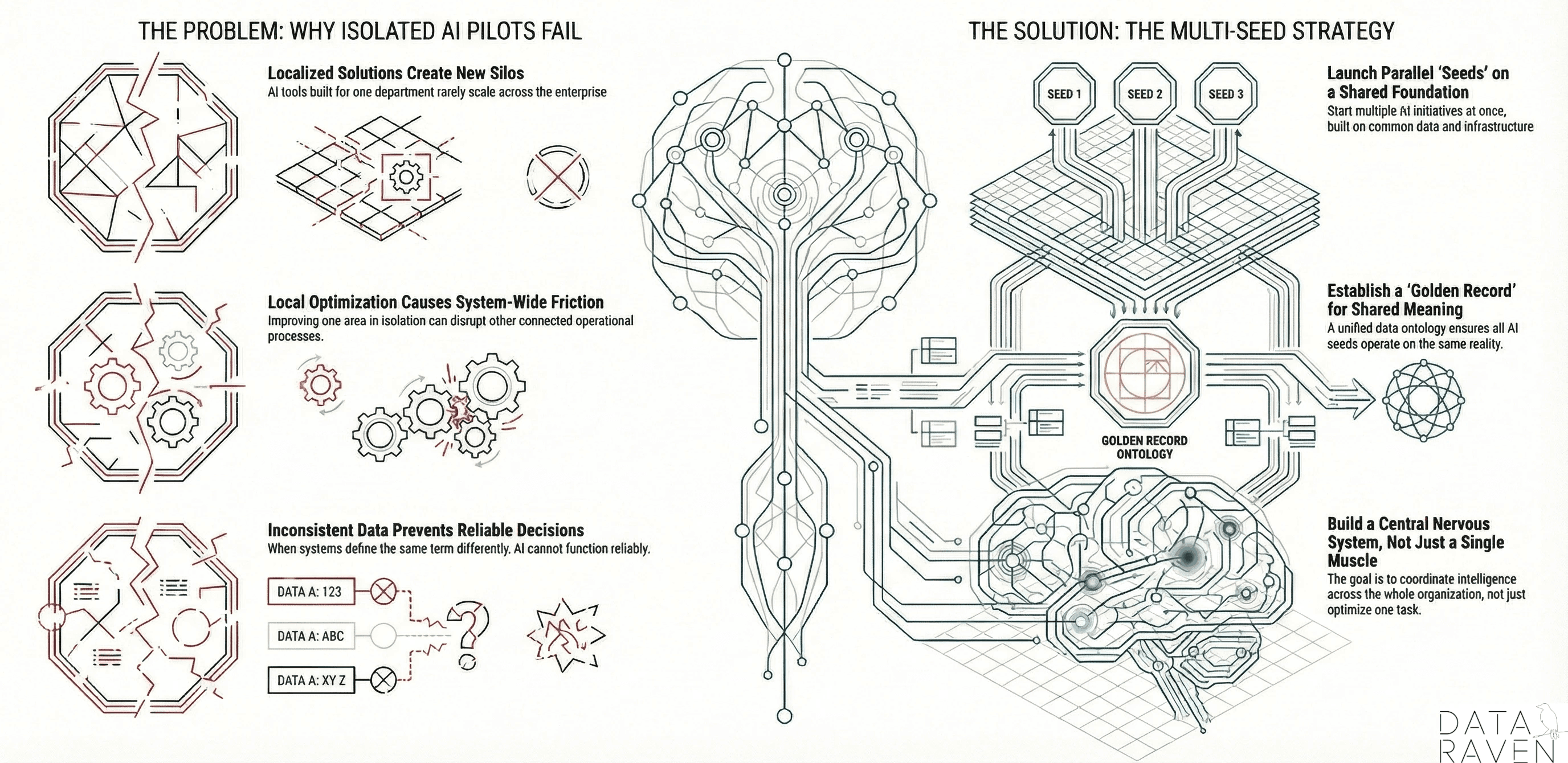
Industrial and service-driven organizations don’t struggle with AI because of a lack of technology or data.
They struggle because AI is often introduced as a localized solution — a pilot in one department, a tool for one team, or an isolated initiative disconnected from daily operations.
In complex operational environments, this approach rarely scales.
True transformation requires a different mindset: treating AI as an organizational capability, not a collection of disconnected use cases.
This is the foundation of the Multi-Seed Strategy.
Why Isolated AI Initiatives Fail at Scale
Industrial organizations operate as tightly coupled systems. Commercial commitments affect operations. Operational disruptions impact customer service. Service feedback influences future demand.
When AI is deployed in isolation, it may optimize locally — but often creates friction elsewhere.
The multi-seed strategy deliberately launches multiple AI initiatives in parallel, ensuring they grow on a shared foundation rather than forming new silos.
In industrial and service-driven organizations, these initiatives are often seeded across multiple core domains, for example:
Sales and Commercial Operations
Operations and Production Planning
Customer Service and Field Support
These are illustrative examples, not a prescribed structure.
The critical principle is that each initiative delivers immediate value, while being designed from day one to connect to the others through shared data, common definitions, and aligned ownership.
From Parallel Seeds to a Unified Capability
Each AI “seed” addresses a real operational need.
A commercial agent may identify opportunities or support sales initiatives
An operational agent may dynamically adapt plans to real-world constraints
A service agent may assist teams in resolving issues faster and more consistently
On their own, these capabilities create measurable improvement.
Together — when built on shared foundations — they form an enterprise intelligence layer that spans the organization.
The Golden Record: Why Shared Meaning Matters More Than Models
The biggest constraint in enterprise AI is rarely algorithmic sophistication.
It is semantic misalignment.
In industrial environments, the same entity — a product, customer, order, or asset — often has different meanings across ERP, CRM, MES, and service systems. AI trained on inconsistent definitions cannot reliably support decisions.
A scalable AI strategy therefore requires a Unified Ontology, often referred to as a Golden Record.
By defining shared business entities, attributes, and relationships, every AI initiative — regardless of where it is seeded — operates on the same underlying reality.
This alignment allows AI to move from analysis to execution without increasing operational risk.
Infrastructure Built for Continuity, Not Disruption
Industrial and service organizations cannot afford disruptive transformations. AI must integrate into live environments and evolve over time.
A multi-seed strategy naturally drives the creation of shared infrastructure, including:
Common Data Foundations
Secure ingestion pipelines and governed data layers reusable across initiativesReusable AI Components
Shared context stores, models, and reasoning layers serving multiple domainsAligned Governance
Clear ownership, security, explainability, and lifecycle management — without slowing deliveryInstitutional Knowledge Preservation
AI grounded in internal procedures, historical events, and operational decisions, ensuring expertise survives scale and turnover
This foundation ensures continuity while enabling ongoing innovation.
Cross-Organizational Intelligence: Where Real Value Emerges
The real advantage of a multi-seed approach appears when AI connects signals across domains.
Service insights reveal recurring operational friction.
Operational constraints shape commercial commitments.
Commercial demand feeds back into planning and prioritization.
These feedback loops transform fragmented processes into a coordinated intelligence system — one that continuously learns and adapts.
At this stage, AI is no longer just a tool.
It becomes part of how the organization thinks and operates.
A Disciplined Roadmap to Execution
Successful AI transformation does not start with technology.
It starts with framing.
A Framing Phase validates feasibility, defines scope, and designs a high-level architecture before major development begins. This ensures:
Clear ownership and integration paths
Controlled scope, risk, and budget
A scalable design aligned with operational reality
The objective is not experimentation.
It is sustainable execution.
A Simple Analogy
Implementing AI through multiple seeds is like installing a central nervous system, not adding a single muscle.
One muscle may optimize a specific task.
A nervous system coordinates sensing, decision-making, and action across the entire body.
That is the difference between AI pilots — and AI that truly transforms industrial and service-driven organizations.
Industrial and service-driven organizations don’t struggle with AI because of a lack of technology or data.
They struggle because AI is often introduced as a localized solution — a pilot in one department, a tool for one team, or an isolated initiative disconnected from daily operations.
In complex operational environments, this approach rarely scales.
True transformation requires a different mindset: treating AI as an organizational capability, not a collection of disconnected use cases.
This is the foundation of the Multi-Seed Strategy.
Why Isolated AI Initiatives Fail at Scale
Industrial organizations operate as tightly coupled systems. Commercial commitments affect operations. Operational disruptions impact customer service. Service feedback influences future demand.
When AI is deployed in isolation, it may optimize locally — but often creates friction elsewhere.
The multi-seed strategy deliberately launches multiple AI initiatives in parallel, ensuring they grow on a shared foundation rather than forming new silos.
In industrial and service-driven organizations, these initiatives are often seeded across multiple core domains, for example:
Sales and Commercial Operations
Operations and Production Planning
Customer Service and Field Support
These are illustrative examples, not a prescribed structure.
The critical principle is that each initiative delivers immediate value, while being designed from day one to connect to the others through shared data, common definitions, and aligned ownership.
From Parallel Seeds to a Unified Capability
Each AI “seed” addresses a real operational need.
A commercial agent may identify opportunities or support sales initiatives
An operational agent may dynamically adapt plans to real-world constraints
A service agent may assist teams in resolving issues faster and more consistently
On their own, these capabilities create measurable improvement.
Together — when built on shared foundations — they form an enterprise intelligence layer that spans the organization.
The Golden Record: Why Shared Meaning Matters More Than Models
The biggest constraint in enterprise AI is rarely algorithmic sophistication.
It is semantic misalignment.
In industrial environments, the same entity — a product, customer, order, or asset — often has different meanings across ERP, CRM, MES, and service systems. AI trained on inconsistent definitions cannot reliably support decisions.
A scalable AI strategy therefore requires a Unified Ontology, often referred to as a Golden Record.
By defining shared business entities, attributes, and relationships, every AI initiative — regardless of where it is seeded — operates on the same underlying reality.
This alignment allows AI to move from analysis to execution without increasing operational risk.
Infrastructure Built for Continuity, Not Disruption
Industrial and service organizations cannot afford disruptive transformations. AI must integrate into live environments and evolve over time.
A multi-seed strategy naturally drives the creation of shared infrastructure, including:
Common Data Foundations
Secure ingestion pipelines and governed data layers reusable across initiativesReusable AI Components
Shared context stores, models, and reasoning layers serving multiple domainsAligned Governance
Clear ownership, security, explainability, and lifecycle management — without slowing deliveryInstitutional Knowledge Preservation
AI grounded in internal procedures, historical events, and operational decisions, ensuring expertise survives scale and turnover
This foundation ensures continuity while enabling ongoing innovation.
Cross-Organizational Intelligence: Where Real Value Emerges
The real advantage of a multi-seed approach appears when AI connects signals across domains.
Service insights reveal recurring operational friction.
Operational constraints shape commercial commitments.
Commercial demand feeds back into planning and prioritization.
These feedback loops transform fragmented processes into a coordinated intelligence system — one that continuously learns and adapts.
At this stage, AI is no longer just a tool.
It becomes part of how the organization thinks and operates.
A Disciplined Roadmap to Execution
Successful AI transformation does not start with technology.
It starts with framing.
A Framing Phase validates feasibility, defines scope, and designs a high-level architecture before major development begins. This ensures:
Clear ownership and integration paths
Controlled scope, risk, and budget
A scalable design aligned with operational reality
The objective is not experimentation.
It is sustainable execution.
A Simple Analogy
Implementing AI through multiple seeds is like installing a central nervous system, not adding a single muscle.
One muscle may optimize a specific task.
A nervous system coordinates sensing, decision-making, and action across the entire body.
That is the difference between AI pilots — and AI that truly transforms industrial and service-driven organizations.


All rights reserved to Data Raven Technologies