Three AI Capabilities, One Backbone
Case study: a multi-stream AI program for a global industrial manufacturer

Most organizations start their AI journey with a single tool for a single team. A year later they have several disconnected tools, each with its own data, its own rules and its own maintenance burden. This case study describes a different path: a multi-stream AI program we are delivering for a global manufacturer of advanced industrial equipment, built on the client’s own cloud and under full IT and security governance.
The starting point
The company’s most valuable asset is the knowledge it has built over years – in its codebase, its support history and its configuration expertise. But that knowledge was spread across systems, teams and countries. Developers spent time on bugs that escaped to QA, support teams in different territories gave uneven answers to the same problem, and validating a product configuration took days of manual work.
The goal was not “to use AI”. It was to make that knowledge AI-ready, and more valuable with every run.
Three capabilities, chosen on purpose
After a wider review of possible use cases, three were chosen because each had a clear business owner, measurable outcomes and a realistic path to production.
Developer quality assurance. A structured, AI-assisted workflow from requirements verification through test generation and code review to a pull request with an evidence pack and a GO / CONDITIONAL-GO / NO-GO recommendation.
Customer-support troubleshooting. A grounded assistant, connected to approved procedures, past cases and the ticketing system, that answers with evidence and prepares a structured escalation packet for R&D.
Product configuration. An optimizer connected to the ERP that produces ranked, explainable configuration recommendations for review and approval.
One backbone instead of three tools
All three capabilities run on a single shared backbone for orchestration, governance, knowledge and monitoring. It is provisioned once and used by every stream, so the next business area can join without rebuilding infrastructure. A shared ontology – canonical entities, synonyms, disambiguation rules and awareness of each source system – lets all three understand the business in the same way.
The design is LLM-agnostic. Models run on private endpoints with no data retention, behind an abstraction layer, while knowledge lives in a versioned, governed knowledge base that the company owns. The model can be replaced; the knowledge stays.
Trust engineered in, not added later
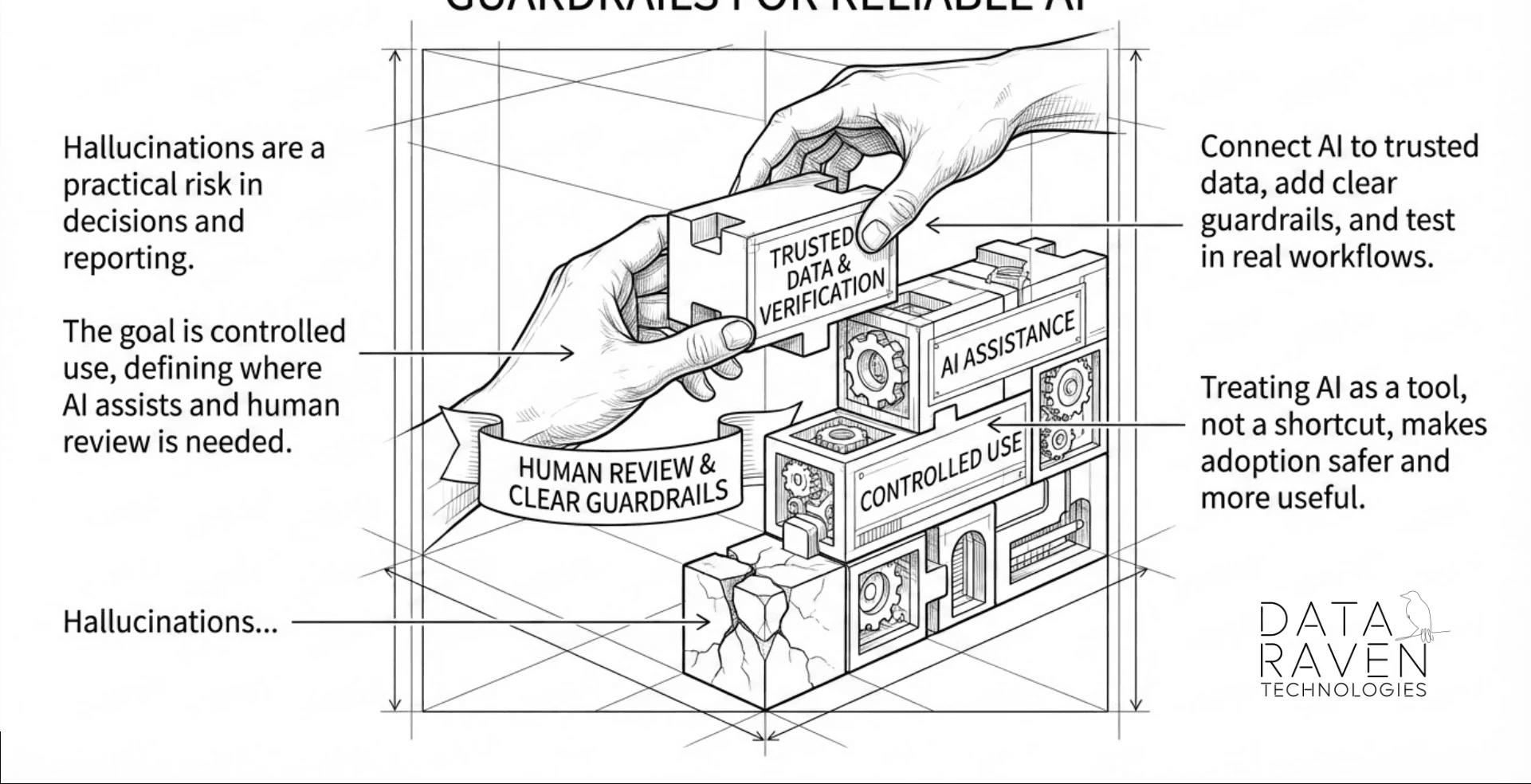
Every source has a trust level – the model’s own guess, ticket text, the approved knowledge base and, at the top, the ontology. Anything below the level required for an answer is blocked before it reaches the model. Changes to knowledge, policy and ontology pass through human approval gates, logged with identity and time, and each business domain has its own approver. In every workflow, the AI recommends and a person decides.
Phase-gated, with a real go/no-go
Each stream started with an agreed baseline, a target, a KPI owner, a go/no-go decision point and a rollback path. Phase 1 delivers one working capability per stream, on real users and real data. Prototype code is treated as disposable – every module is tagged Port, Rebuild, Drop or Reference against the production architecture – and rollout moves from MVP through hardening and user acceptance testing to production handoff with a support period. The business only scales what the evidence supports.
Engineering for operability
Consolidating the architecture removed seven cloud services from the original design, including separate databases, search and caching services and duplicated environments. The result is a smaller platform that the client’s IT team can secure, monitor and support – optimized for operability rather than for an impressive diagram.
What other organizations can take from it
Start from the knowledge you already have, not from the model. Choose a few areas with clear owners and measurable outcomes. Build the shared foundation once, design trust into it, and let evidence – not enthusiasm – decide what scales.
Further reading: AI Project Success: A 4-Part Guide to Implementation · Guardrails for Reliable AI · Ontology for AI in Smart Manufacturing


All rights reserved to Data Raven Technologies