How to Lead Transformation in the GenAI Era
Not just a technology project, but a change-management journey

Giving speeches and posting about GenAI is easy. Creating value with it is hard. For that to happen you need a process, and you need to empower employees to become partners in building GenAI-based processes around a “North Star”: a vision that redefines how work gets done.
GenAI has entered the workplace, but its impact is still elusive. Although two-thirds of companies worldwide already use GenAI, these projects are completely different from earlier enterprise software projects. CEOs increasingly understand GenAI’s potential, but it is still unclear to them how to create real value from the technology.
GenAI has the potential to transform workflows entirely. Its natural-language interface makes it easy to use, and its evolving reasoning and agent capabilities allow it to handle increasingly complex tasks, such as interpreting huge amounts of information, writing code and answering questions. The most advanced agents are already starting to perform tasks like creating Excel spreadsheets and navigating web pages. Employees are eager to use it; they already do so three times more than managers think.
But introducing a new technology does not guarantee effective use, and it does not bring deep change on its own. Change management in this era requires a new approach: turning employees from passive users into active partners and internal entrepreneurs who practice, experiment, create and develop new skills.
This article presents four key steps CEOs can use to lead their organization into the GenAI era.
Step 1: Define a “North Star” as the anchor for the change
The North Star should not presuppose how solutions will be implemented. It should serve as an anchor for the organization’s purpose and vision, explaining where the company wants to go and what value it wants to create. The vision should be simple enough for everyone to understand but bold enough to inspire teams. It should keep pace with the technology and absorb new capabilities within a reasonable time. Above all, the North Star must define how the organization will create competitive advantage from GenAI and what the impact on people will be.
To keep the direction focused and measurable, the vision should connect directly to clear business goals. Success metrics should be defined in advance, so the impact of GenAI on productivity, cost savings, quality and financial results can be tracked.
Further reading: Building the Future of Manufacturing: Trustworthy LLMs and Agentic AI
Step 2: Build trust through a controlled process
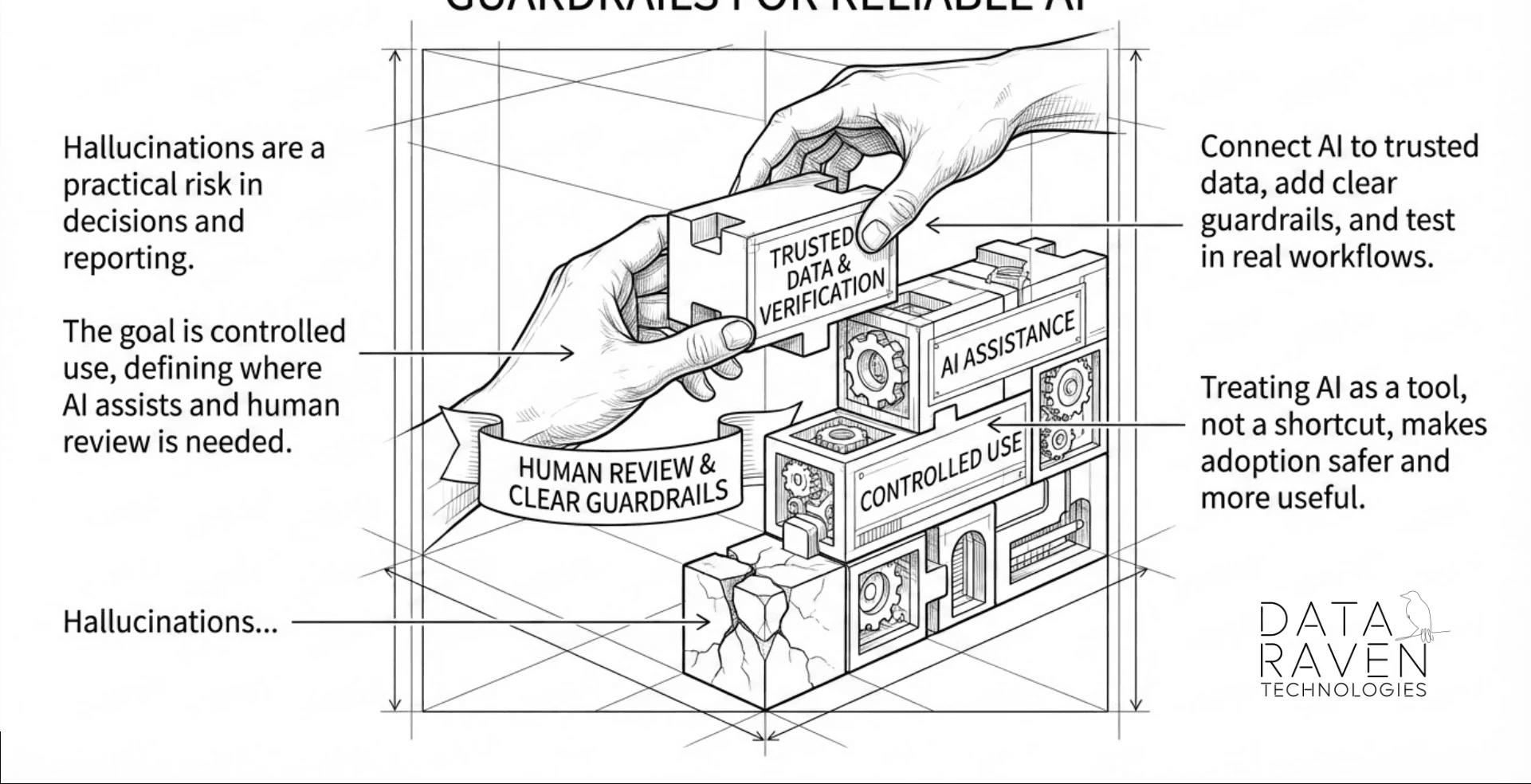
The CEO’s role is not to build trust personally but to make sure the planned process includes checkpoints and governance where model results are tested in practice. Key people in the organization should be involved in implementation, receive tools to evaluate the outputs, and understand how the models work and where their limits are. That way, trust is built not only in the technology but in the work process itself.
At every stage, define human-in-the-loop points to ensure oversight, build trust and prevent cascading errors that could damage the entire process.
The most reliable GenAI platforms are those grounded in internal organizational knowledge, such as research, engineering documentation and customer records, enriched with up-to-date external information.
Further reading: When AI Tools Reach the Field

Step 3: Reimagine workflows for AI teams
Bolting GenAI onto existing processes will have limited impact. Instead, put it at the center and fundamentally change how work is done. The shift progresses in three stages:
Independent agents for small tasks
Groups of agents that run end-to-end processes under human supervision
Autonomous “agent swarms” in lean organizations that run complete business processes
To make adoption successful and let it spread gradually, start with a focused implementation. Begin with a small step and a clear, well-defined solution, then gradually expand GenAI use to broader processes.
In manufacturing especially, there needs to be a tight link between the results of digital planning and what physically happens on the production line. Direct feedback loops from the shop floor to business metrics make it possible to balance output, quality and efficiency in real time.
One example is a plant that manufactures industrial components and brought GenAI into its daily planning. Process engineers consult it when building the daily plan against annual targets, in an environment with high variability in demand and production capacity. The agents enable fast scenario calculations, load-balancing suggestions and analysis of the impact on long-term targets.
Further reading: The Smart Factory – Journey Toward a Data-Driven Future
Step 4: Build a culture of partnership with employees
In the GenAI era, the CEO’s role is not to “empower” employees directly but to create the conditions that let them become real partners in the change. The CEO should make sure the workflows opened up to GenAI are accessible to employees themselves, so they can propose, adapt and build tools and agents that shape their own work and the work of the whole organization.
The CEO should look at how employees become an active part of the change, for example by encouraging participation in practice groups, providing simple tools for internal development, and supporting initiatives that come from the field. This creates a culture in which employees don’t just receive technology but actively shape it.
In this scenario, internal ambassadors lead adoption, coach their peers and build internal momentum. The CEO, in turn, makes sure this culture is sustained and has the resources and organizational structure it needs to keep evolving over time.
Further reading: Why 95% of Generative AI Pilots Fail?
From the field: one backbone for every new area
A North Star needs a foundation that can carry it. In a program we are delivering for a global manufacturer of advanced industrial equipment, three AI capabilities – for R&D, customer support and product configuration – run on one shared backbone for orchestration, governance, knowledge and monitoring. It is built once and used by every stream.
That choice changes what scaling means. When the next business area is ready, it joins an existing foundation, with its governance, approval gates and audit trail already in place, instead of starting another isolated project. For CEOs, this is the practical difference between a series of pilots and an organizational capability.
Read the full case study: Three AI Capabilities, One Backbone
Summary
CEOs need to define a clear North Star today, one that anchors the purpose of change in the organization, and to lead a broad transformation in which people and AI work together to achieve exceptional results. Change management in the GenAI era requires a culture of experimentation, where employees are not passive recipients of technology but active partners in shaping it. Instead of seeing GenAI as a threat, see it as an organizational superpower: an invisible but essential work partner.
Other articles that may interest you


All rights reserved to Data Raven Technologies